(Case study · 05)
ORA
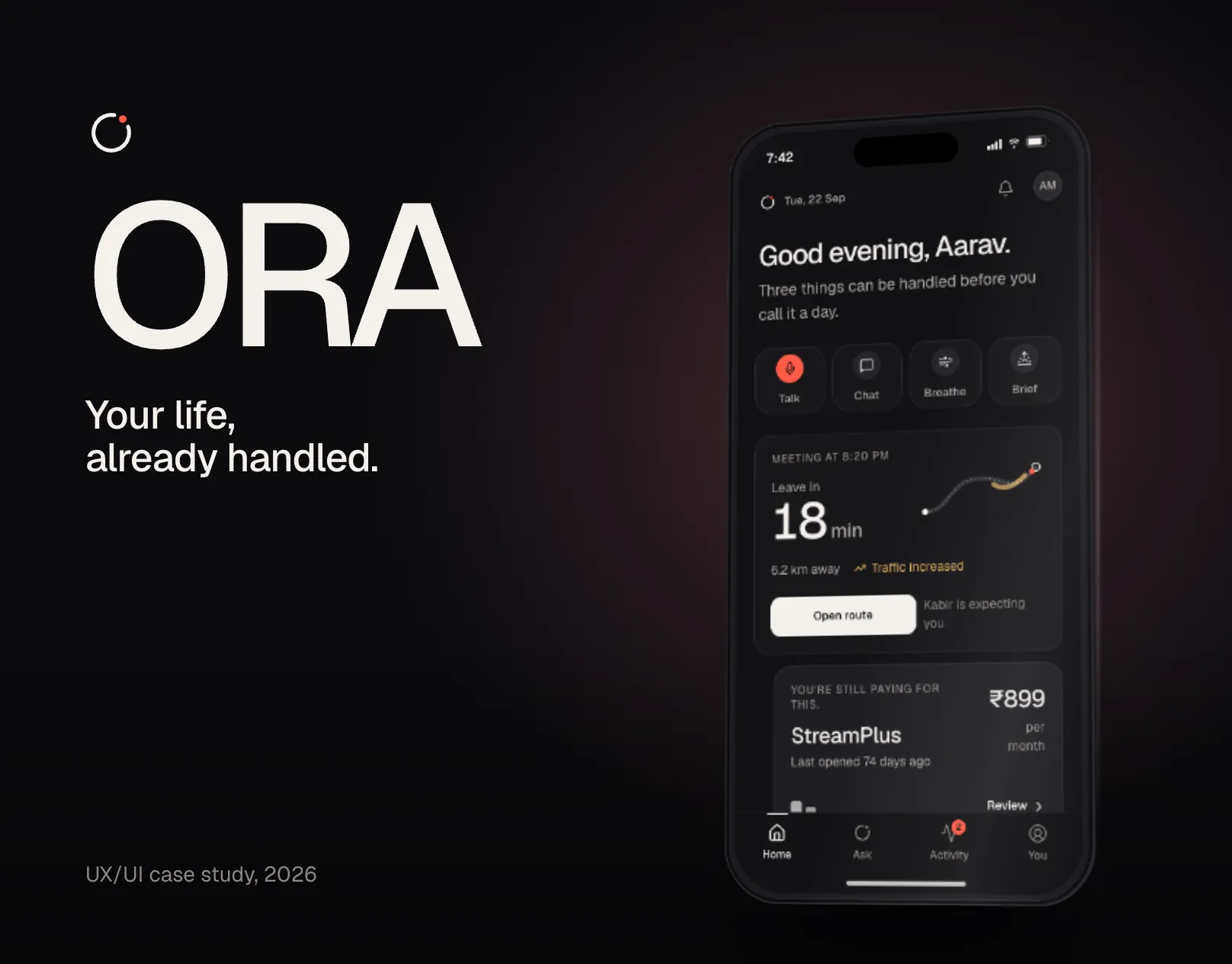
Busy people don't lack apps. They lack one place that turns an outcome into done, safely. ORA takes a sentence like "plan a 3-day Goa trip under ₹20,000" and carries it across calendar, mail, maps, travel, food and bank — showing every step, and asking before it does anything that can't be quietly taken back.
A self-initiated UX/UI case study. The user, the evening scenario and every brand in it (StreamPlus, Green Bowl, Northwind Studio) are written for the demo — no real people, accounts or transactions.
(Why I made this)
What would it take to trust an assistant with your evening?
Busy people don't lack apps. They lack one place that turns an outcome into done.
Assistants answer questions, but they don't finish the job. And handing one your money or your messages doesn't feel safe, because you can't see what it's doing.
I wanted to design the opposite: say the outcome once, watch every step, and stay the one who says yes.
(What I looked at)
Before designing anything
This is desk research and design audits, as the ORA case study describes them. There were no interviews or participants, and the person in the scenario is illustrative.
- Desk research
- Articles and app reviews on assistants, calendars, travel and subscriptions.
- Category audit
- Voice, chat and to-do apps, compared on the same five evening tasks.
- Task mapping
- Every step, app and hand-off needed to finish those five tasks.
- Trust review
- Where assistants act, what they show, and where they ask.
(What changed because of it)
Insight, decision, screen
The four insights from the ORA case study
The pain is coordination, not difficulty: switching and remembering.
Say the outcome once; ORA turns the sentence into fields you can check and change.
Ask
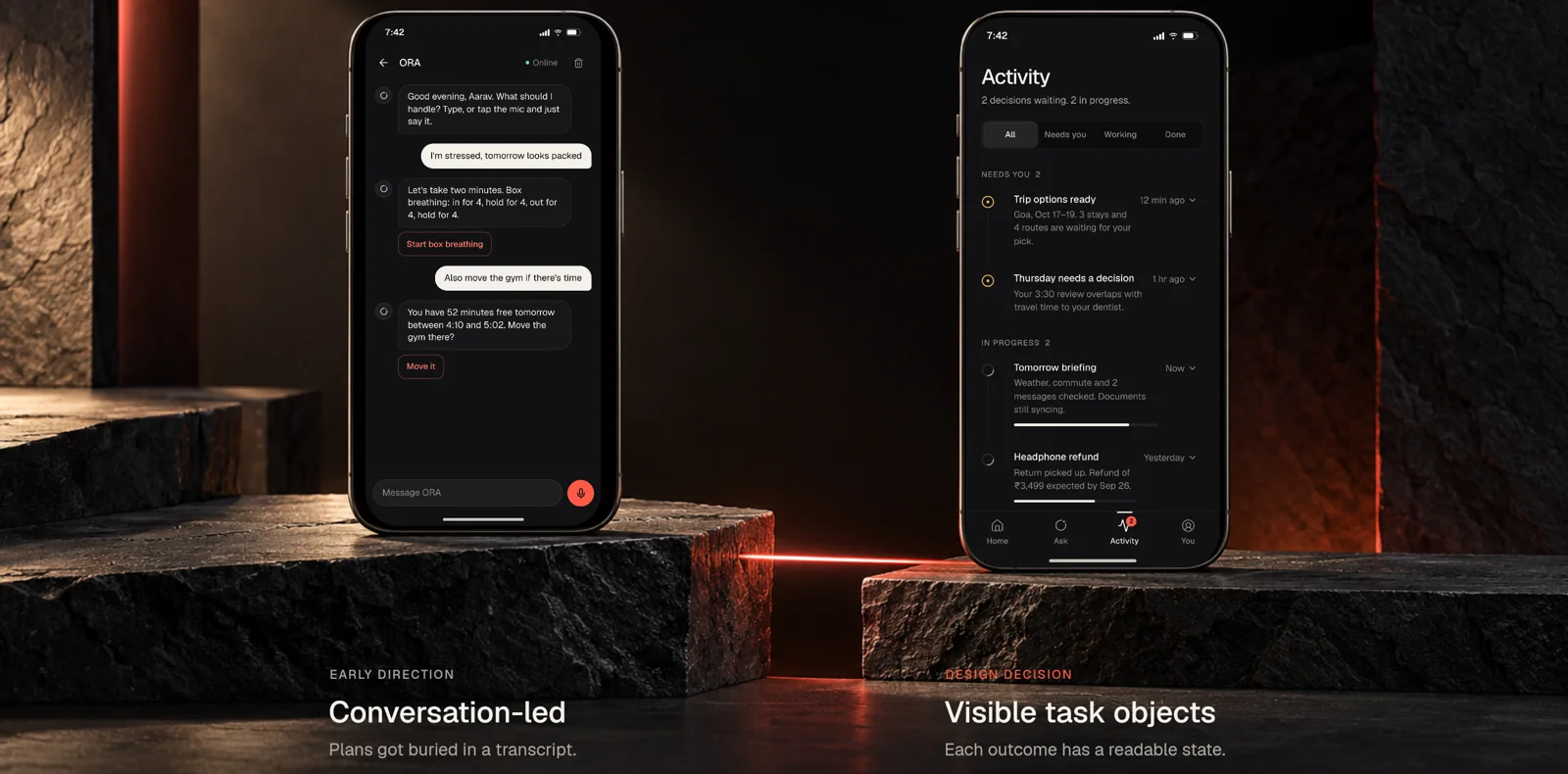
In a chat, it's hard to see what's done, pending or waiting on you.
Every outcome is a task with a named stage: queued, checking, ready, needs approval, done.
Activity
Trust needs a checkpoint.
One approval sheet answers what, why, when, what it costs and how to undo it.
Approval sheet
Money needs care.
Nothing that spends, sends or schedules happens without a yes.
Home and Activity
(What didn't work)
Eight directions, four kept
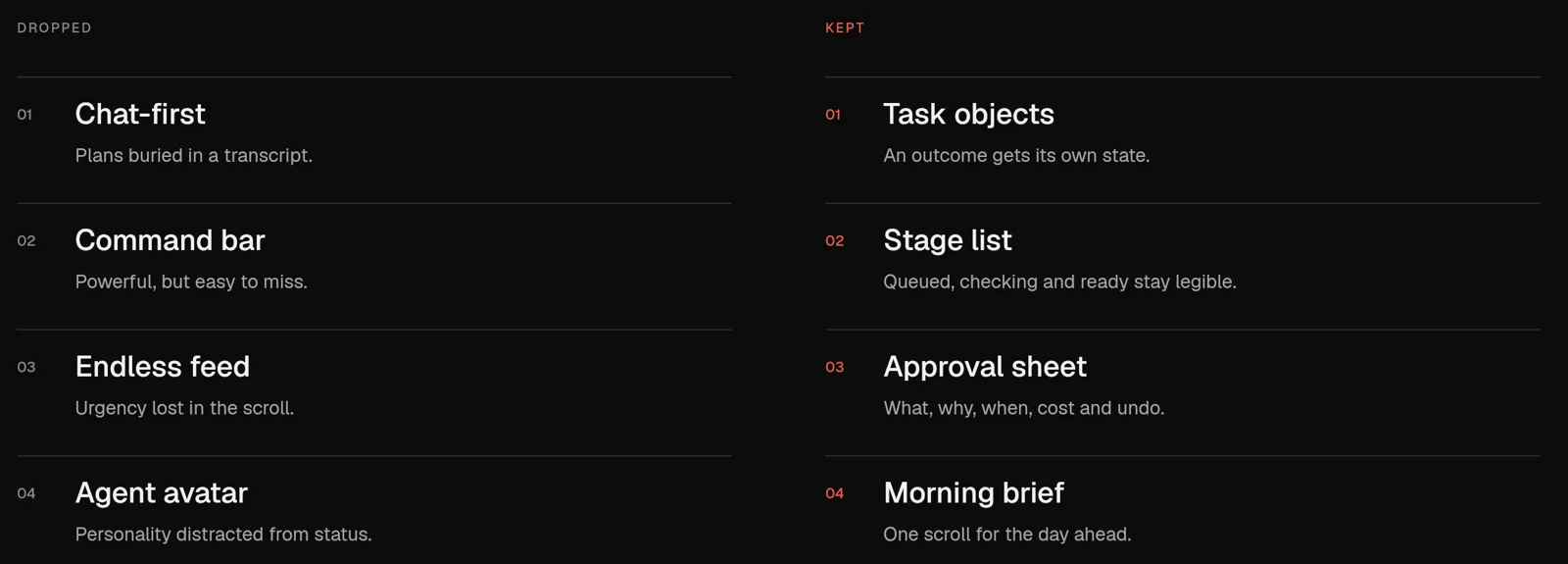
I examined eight directions against the same five evening tasks. A conversation-led assistant was the obvious start, and it was wrong: plans got buried in a transcript.
What survived made the work visible instead of something to reread: task objects, a stage list, an approval sheet and a morning brief.
(Information architecture)
Four tabs, one rule
The tabs follow the life of an outcome: what matters now, asking for something, watching it happen, and deciding how far ORA may go on its own.
ORA
- Home
- Time-critical first
- Talk · Chat · Breathe · Brief
- Morning brief
- Ask
- One big field
- Describe the result, not the steps
- Activity
- All · Needs you · Working · Done
- Everything on record
- You
- Per action: allow · ask first · never
- Calendar, email and more
(Flow)
One outcome, from a sentence to done
01 · An outcome
- "Plan a 3-day Goa trip under ₹20,000"
- Where · how long · budget
- Queued
- Checking
- Ready
- Needs approval
- Approved
- Done, on record
- Undo where possible
(Values)
What I refused to compromise
Nothing consequential without a yes
Sending, scheduling and spending all stop at one sheet first.
Everything on record
What ORA did stays in Activity, reversible where possible.
Status without colour
Colour always comes with a shape and a word, so a state reads for everyone, including colour-blind users.
Control before autonomy
Every capability is allow, ask first or never, earned per action rather than granted all at once.
(Mood board)
Calm by default, loud only when it matters
Near-black warm ink and one vermilion. The mark is a path that almost closes, and the vermilion dot is the last step: the part ORA completes once you approve.
Colours sampled from ORA's own design-system screen
- Ink
#0C0B0E - Surface
#171719 - Raised
#1E1D22 - Paper
#F4F1EB - Muted
#A9A8A2 - Vermilion
#FF5A46 - Amber
#F3B35E - Done
#73D6A9
- Calm
- Legible
- In control
- Quietly capable
(What I made)
A design system and a working prototype
I designed ORA end to end, 40+ screens and states across eight end-to-end flows with voice, and built a working prototype in Next.js, React, TypeScript, Tailwind, Motion and Zustand.
- Outcome to fields
- Named stages, never a spinner
- One approval sheet
- Activity on record
- Allow · ask first · never
- Morning brief
- Voice
- Design system
The screens
An AI assistant that finishes things instead of answering them: you name an outcome, it does the work across your apps, and it stops for one approval sheet before anything sends, schedules or spends.
(Up close)
The approval sheet
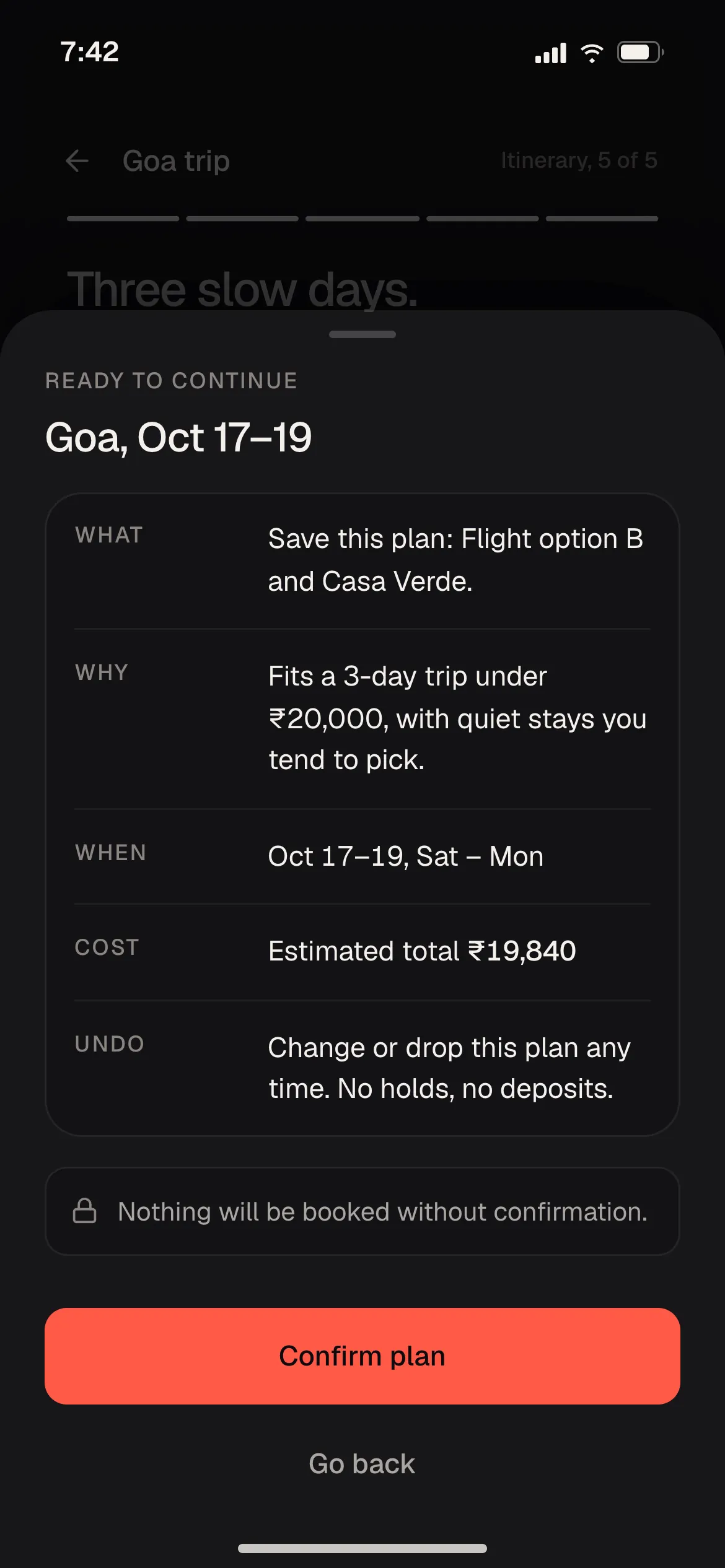 123456
- What will happen, in one line
- Why ORA chose it
- What it costs, as an estimate
- How to undo it
- "Nothing will be booked without confirmation"
- One clear yes
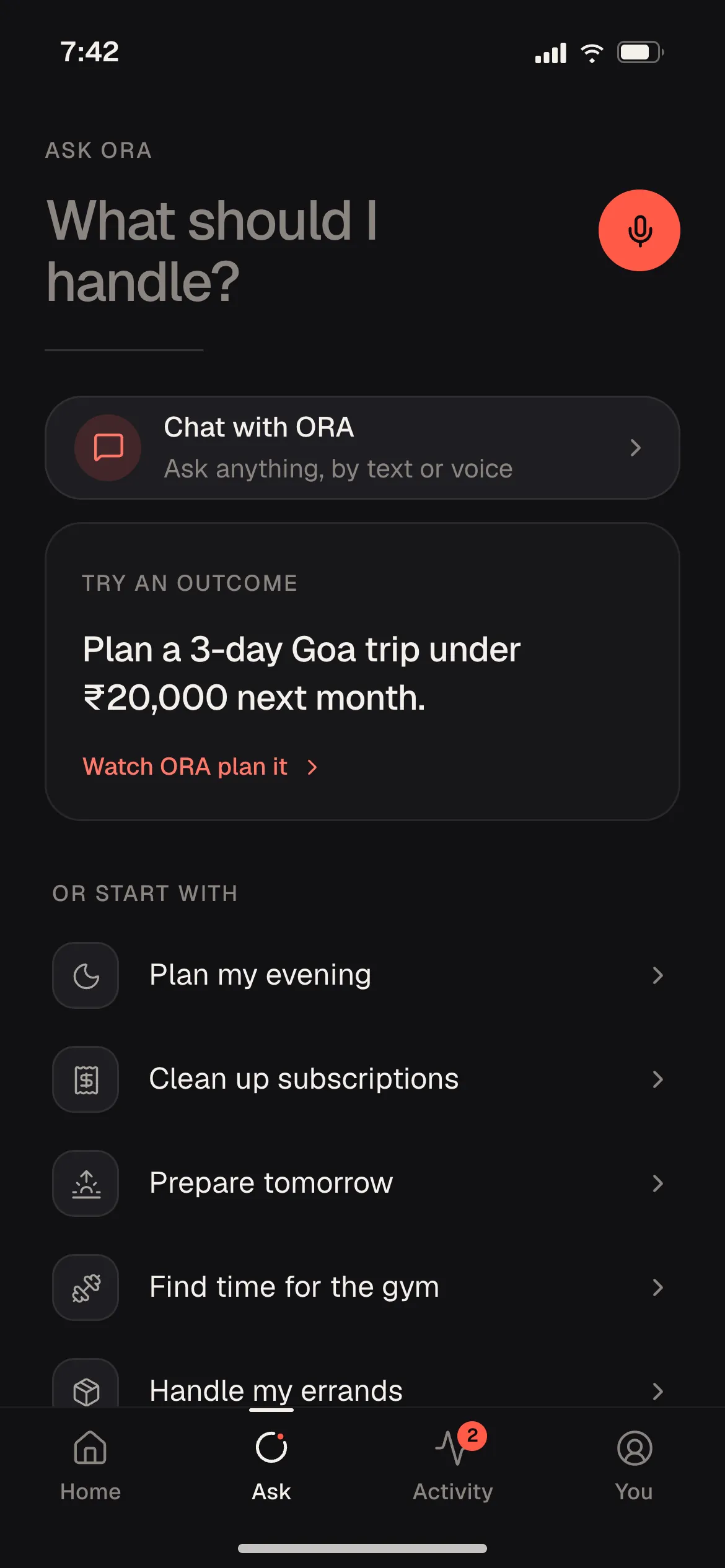 1234
- "What should I handle?": you describe the result, not the steps
- Chat with ORA, by text or voice
- Try an outcome: a whole trip in one sentence
- Or start from common outcomes
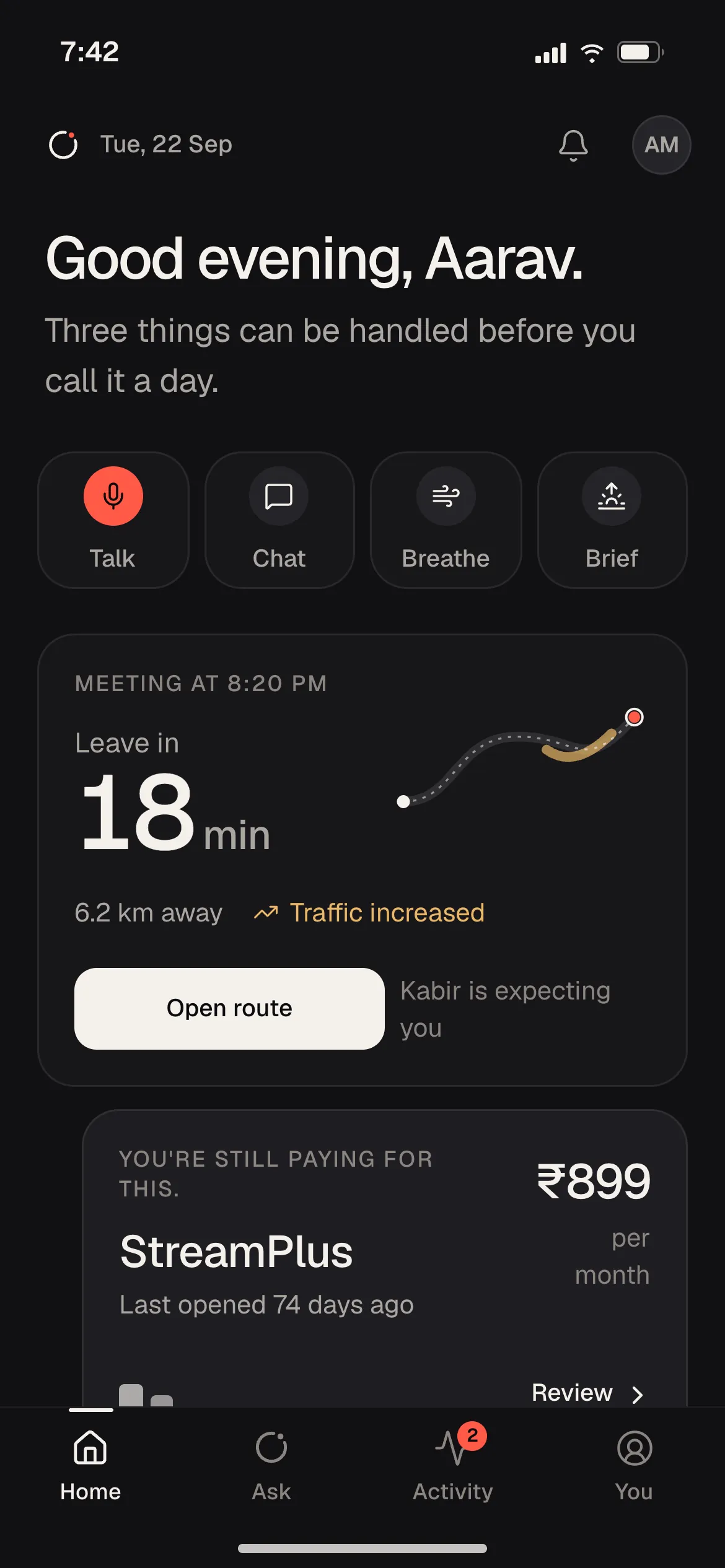 1234
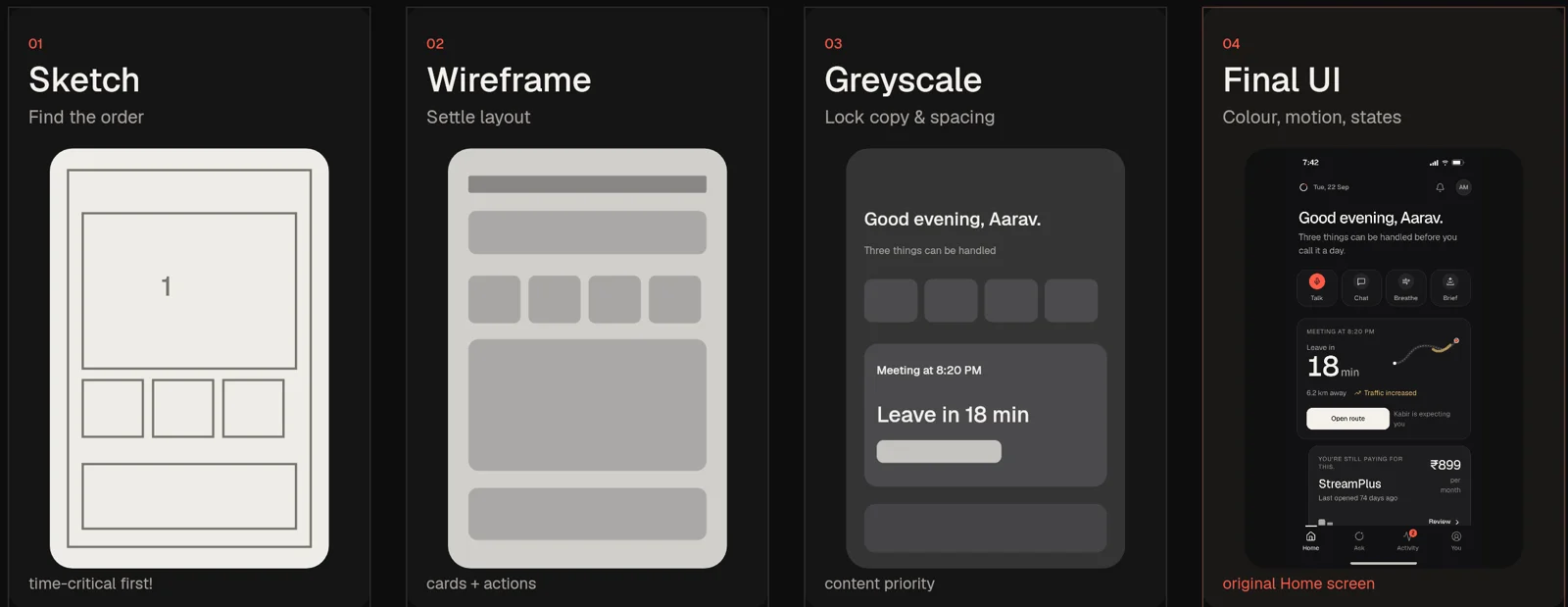
- "Three things can be handled before you call it a day"
- Talk, chat, breathe or a brief
- Time-critical first: leave in 18 minutes
- Money needs care: a subscription last opened 74 days ago
(What this is)
A concept, said plainly
ORA is a self-initiated UX/UI case study with a working prototype. The person, the evening and every brand in it are written for the demo: no real people, accounts or transactions, and no user testing is claimed.
- Scope
- 40+ screens, 8 end-to-end flows, voice
- Prototype
- Next.js · React · TypeScript · Tailwind · Motion · Zustand
- Data
- Entirely fictional
(What I learned)
ORA changed how I think about AI products. The interesting design problem isn't what the AI can do. It's how a person stays in charge of it.
Need something like ORA?
Tell me what you want to build. I'll reply with how I'd build it, a rough timeline and a cost range. Free, and no obligation.
Next project
Plinth